CZITCZAT Study / Visual Law / Fashion Court / Object Lesson
Fashion Is Art, But Who Becomes the Exhibit?
A scroll-led CZITCZAT Study on celebrity objecthood, drag-coded CGI illustration, and the difference between wearing couture and becoming cultural evidence.
Thesis FirstThe page opens with the argument. The images arrive as magnified clues, then close the study as full Visual Testimonies.
Released May 31, 2026Filed as: CZITCZAT Study / Visual Law / Fashion Court / Object Lesson.
Publication TypeStandalone CZITCZAT Study, not a numbered issue.
Visual Law / Elements of Design / Cultural Evidence
It is a museum threshold, a cultural courtroom, and a stage where celebrity is asked to justify itself through fashion. The strongest looks are not always the prettiest, the most expensive, or the most technically extravagant. They are the looks where the celebrity stops appearing dressed and starts appearing installed.
That is the difference between wearing art and becoming the exhibit.
At the center of this year’s fashion conversation were two archetypes: The Manufactured Muse and The Monumental Performer.
One arrived as an object.
One arrived in spectacle.
One transformed the public language around her image into sculpture.
One wore an extraordinary garment that did not fully surrender to her biography.
The distinction matters because the Met Gala is not only about glamour. It is about authorship. It asks a brutal question of every famous body on those steps:
Can your image survive being turned into art?
And more importantly:
Are you wearing the garment, or is the garment wearing you?
Court Check 01
What are you judging first when you see a Met Gala image?
Receipt captured.
Study Sequence 02 / Standalone CZITCZAT Study
The Met Gala Is Not a Music Video
A red carpet can reward beauty.
A tour stage can reward scale.
A music video can reward fantasy, choreography, lighting, editing, wind, smoke, hair, and narrative interruption.
The Met Gala is colder than that.
It is not asking a celebrity to look good. That is the entry fee. It is asking the celebrity to become a thesis. It is asking their public image, their body, their scandals, their mythology, their labor, and their archive to merge into one object under institutional lighting.
That is why expensive does not automatically equal important. A garment can cost a fortune and still feel like costume. A look can be technically perfect and still fail to haunt the room. A celebrity can arrive covered in crystals, feathers, diamonds, custom construction, and archival references — and still leave the viewer with the sense that the fashion spoke louder than the person.
The Met Gala does not reward the best outfit.
It rewards the clearest transformation.
It rewards the person who understands the museum does not need another beautiful guest.
It needs an artifact.
Court Check 02
What should the Met Gala reward most?
Signal logged.
Study Sequence 03 / Standalone CZITCZAT Study
Visual Law Stands on the Elements of Design
CZITCZAT does not critique culture through opinion alone.
CZITCZAT investigates culture through testimony, archive, and the elements of design.
That is the foundation of Fashion Court.
Not gossip.
Not stan war.
Not a best-dressed list.
Court.
Every image leaves evidence.
The evidence is visual.
Line tells the eye where to travel.
Shape creates the silhouette.
Form decides whether the body feels flat, sculptural, human, object, garment, or monument.
Value controls the hierarchy of light.
Color creates emotional authority.
Texture tells the viewer what the image wants to feel like before it is touched.
Space decides what is being claimed and what is being withheld.
Scale measures the relationship between body and object.
Emphasis reveals what the image demands we see first.
Movement controls how the eye travels through the frame.
Unity decides whether the look belongs to itself.
Contrast exposes the tension.
This is Visual Law.
Visual Law asks:
What is the image proving?
And then:
By what evidence?
The strongest look does not win because it is prettier, richer, louder, or more famous. It wins when the elements of design align into a clear visual thesis.
That is why The Manufactured Muse succeeded.
The shape was more distinct.
The hierarchy was more controlled.
The contrast was more intentional.
The concept was more unified.
The visual thesis was more specific.
The image became inseparable from the mythology.
The Monumental Performer carried grandeur, but grandeur is not automatically authorship. A garment can be expensive and still fail to submit to the body’s archive. A look can sparkle and still lack visual law. A celebrity can arrive in spectacle and still leave the garment as the headline.
Fashion Court does not ask:
Who won?
Fashion Court asks:
How was meaning constructed?
What visual system produced the outcome?
Who became the evidence?
That is where fashion criticism becomes discipline.
Evidence Check
Which design element controls an image first for you?
Visual evidence entered.
Study Sequence 04 / Standalone CZITCZAT Study
The Manufactured Muse: When the Object Walks
The Manufactured Muse understood the assignment because she did not try to humanize herself.
She did the opposite.
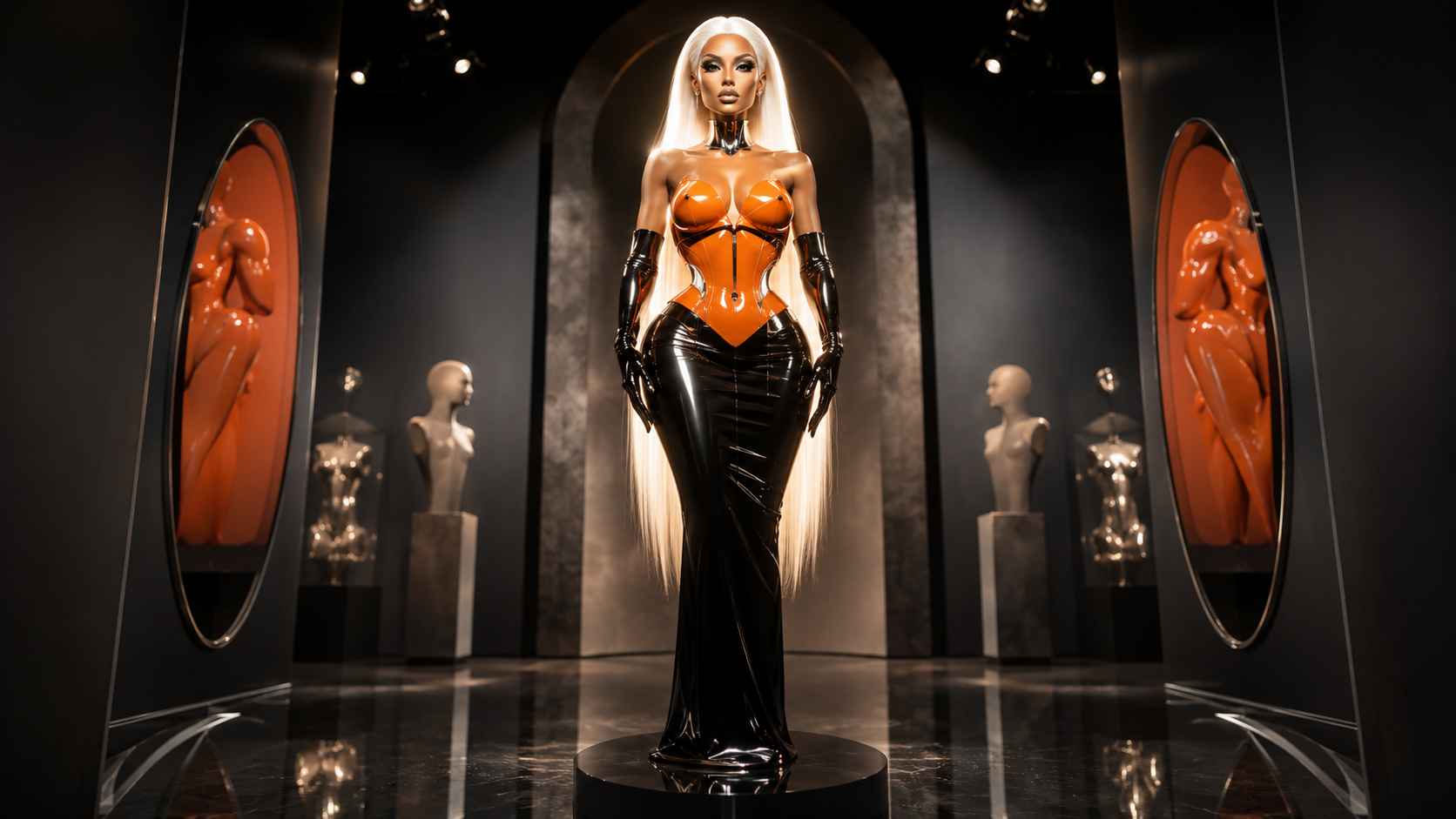
She entered as something lacquered, cast, polished, and preserved. Her body did not read as dressed. It read as produced. The blonde hair did not read as blonde hair. It read as light. Her face did not read as glam. It read as finish. The body did not appear softened by fabric. It appeared sealed inside a visual argument.
The effect was unsettling because the look did not ask to be liked.
It asked to be studied.
This is where the look became powerful.
The Manufactured Muse has always lived inside a public conversation about the body as product: body as brand, body as commodity, body as surveillance object, body as fantasy, body as accusation. Her image has been praised, mocked, desired, copied, condemned, and consumed. At the Met, she did not run from that mythology. She sharpened it.
She transformed the public language around her image into sculpture.
A mannequin.
A sculpture.
A fetish object.
A luxury product.
A pop-art relic.
A body turned into commerce, then turned back into art.
That is not just styling.
That is strategy.
The molded body-armor effect mattered because it created distance from softness. It stripped away the illusion of effortless beauty and replaced it with surface, gloss, shell, and control.
The face looked unreal because it needed to look unreal.
The hair looked almost detached from the body because it was not functioning as hair. It was functioning as gallery lighting.
The body became a pedestal for itself.
That is why the look frightened people.
Not because it was monstrous.
Because it was honest.
The Manufactured Muse did not arrive as a woman trying to look beautiful. She arrived as a cultural product willing to be displayed as one.
That is fashion as art.
Object Body Check
Did this archetype become the exhibit?
Object Body receipt filed.
Study Sequence 05 / Standalone CZITCZAT Study
The Monumental Performer: When the Garment Takes the Lead
The Monumental Performer arrived with grandeur, command, and undeniable presence. The craftsmanship was clear. The scale was clear. The drama was clear. The look understood spectacle.
But spectacle is not the same as authorship.
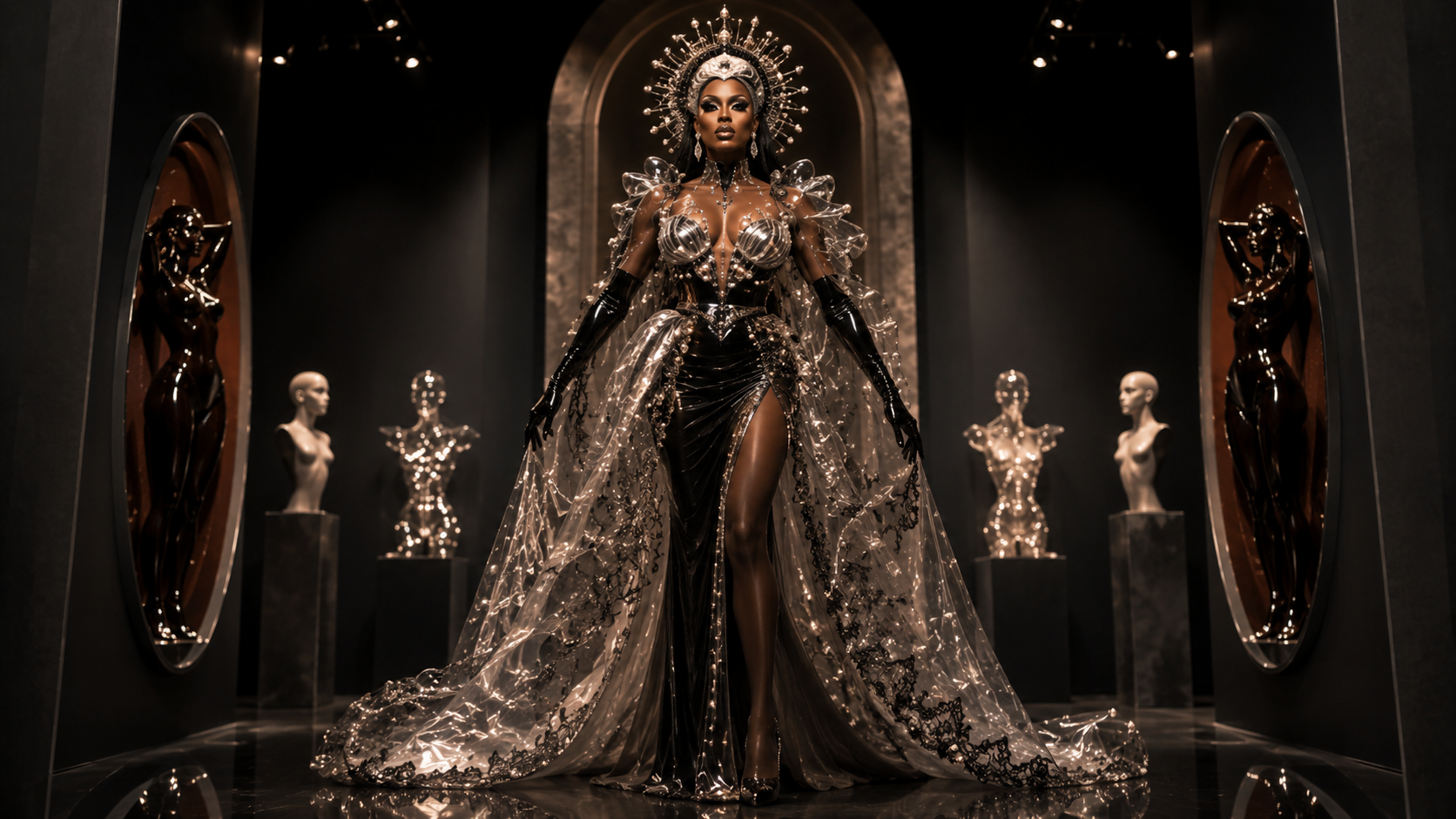
The garment carried a strong visual idea: body, skeleton, crystal, divinity, feathers, crown, stage light, myth. On paper, the elements should have produced a monumental fashion moment. In motion, however, the garment often appeared to be performing harder than the icon inside it.
That is where the imbalance began.
The Monumental Performer is not an ordinary celebrity. Her image carries decades of labor: performance discipline, Southern glamour, church memory, motherhood, vocal athleticism, bodily control, Black womanhood, divine perfection, pop sovereignty, country reclamation, club architecture, blonde transformation, archive, secrecy, and ritual.
She does not need a garment to make her mythic.
She needs a garment that submits to the myth already present.
This look did not fully submit.
It looked expensive.
It looked dramatic.
It looked event-ready.
It looked like a scene.
But at moments, it looked more like a music-video costume than a museum artifact.
That is not an insult. Music-video costume can be extraordinary. It can be iconic. It can define an era. But the Met Gala demands a different kind of stillness. It demands that the image survive without choreography, without a beat drop, without wind machines, without camera cuts, without the performer’s usual command system.
The Monumental Performer’s power is movement.
Her authority is often kinetic.
She builds worlds through performance.
But on the Met steps, the world has to be contained inside one visual sentence.
That sentence needed to be more biographical.
The garment needed to say:
This could only belong to her.
Instead, it said:
This is an extraordinary interpretation of the theme.
That difference is everything.
Costume Body Check
Did this archetype feel like costume, canon, or both?
Costume Body receipt filed.
Study Sequence 06 / Standalone CZITCZAT Study
Costume Is Not Canon
There is a gap between a garment that references a theme and a garment that converts a life into an object.
A theme can be interpreted by anyone.
Canon can only be carried by the person who lived it.
That is where The Manufactured Muse succeeded. Her look did not simply respond to “fashion is art.†It responded to her own image history. It weaponized the public’s discomfort with her artificiality. It made the body a sculpture because the body has always been the site of her public power.
The Monumental Performer needed that same level of self-specific conversion.
The stronger route would not have been more crystals, more feathers, more diamonds, or more volume.
It would have been more authorship.
Imagine a look built from the labor of making the icon: measuring tape as boning, pattern paper as train, gold thimbles as fingertips, Southern church fans as halo, rodeo leather burned into black lace, hairpins forming a crown, mic grilles embedded into the bodice, a corset that appears drafted directly onto the body.
Not simply a star in couture.
The daughter of construction.
The daughter of the seamstress.
The performer as archive.
The body as instrument.
The woman as house, church, stage, and museum.
That would have made the garment bow.
That would have said:
Fashion is art because my life was constructed under pressure, under labor, under gaze, under worship, under expectation, under discipline.
That would have turned spectacle into evidence.
Canon Check
What makes a look feel like it could only belong to one person?
Canon marked.
Study Sequence 07 / Standalone CZITCZAT Study
The Object Body vs. The Costume Body
The Met Gala rewards precision of identity.
The Object Body says:
I know what you have projected onto me.
I know what you have consumed.
I know what you have called artificial.
I know what you have called plastic.
I know what you have called excessive.
Now watch me make it museum-worthy.
The Costume Body says:
I understand the theme.
I have the resources.
I have the team.
I have the scale.
I have the drama.
Both can produce beauty.
Only one produces cultural evidence.
The Object Body is not always warmer, prettier, or more morally comfortable. In fact, it is often colder. It can scare the viewer because it removes the need to be relatable.
It does not ask:
Do you love me?
It asks:
Do you understand the system that made me visible?
The Costume Body can be impressive, but it leaves the celebrity separate from the garment. The audience can imagine another star wearing it. Another face inside it. Another body carrying the same construction.
That is the danger.
At the Met Gala, the best look is not the one that can be worn by anyone with access.
The best look is the one that becomes inseparable from the person wearing it.
Framework Check
Which framework felt stronger to you?
Framework logged.
Study Sequence 08 / Standalone CZITCZAT Study
The Drag of It All
This is why original illustration becomes useful in fashion criticism.
When a direct image cannot or should not be used, the critic is forced to interpret. The reference becomes archetype. The celebrity becomes a figure. The garment becomes a theory. This is not a limitation.
This is where the real visual language begins.
The Manufactured Muse can become a faceless drag sculpture: bleached light-hair, lacquered orange body armor, black patent column, mannequin stillness, gallery floor, oval reflections, body as object, body as product, body as installation.
The Monumental Performer can become a Black Southern Madonna: bubble-crystal ribs, devotional crown, dark lace, pearl relics, opera train, liquid-glass armor, church-shadow lighting, body as altar, body as instrument, body as cultural monument.
Neither illustration needs to copy a person.
Neither needs the exact garment.
Neither needs a celebrity face.
The point is not imitation.
The point is translation.
A strong fashion illustration does not say:
Here is who we are talking about.
It says:
Here is the idea they activated.
That is the CZITCZAT lane.
No stolen image.
No fan-page dependency.
No celebrity worship without critique.
No empty shade.
Visual Law.
Cultural evidence.
Archive work.
Translation Check
Did using abstract CGI archetypes make the critique stronger?
Translation receipt captured.
Study Sequence 09 / Standalone CZITCZAT Study
Why This Matters Beyond Fashion
This matters beyond fashion.
The same Visual Law that shapes a red-carpet image also shapes politics, sports, law, diaspora, advertising, music videos, album covers, architecture, app design, propaganda, AI imagery, and social media posts.
A campaign poster teaches the public who to fear.
A sports photograph turns the athlete into machine, flag, market, or myth.
A courtroom sketch can make a body look guilty before the case is understood.
A diaspora portrait can either flatten a culture into costume or preserve it as living archive.
An album cover can declare an artist’s new era before one note is heard.
An app screen can train behavior before the user notices they are being trained.
An AI image can steal a mood, a face, a body type, a sexual fantasy, or an entire visual lineage and call it innovation.
This is why CZITCZAT does not only ask:
What happened?
CZITCZAT asks:
What does the image prove?
Who did it flatten?
Who did it protect?
Who did it sell?
What must be archived before power erases the evidence?
Fashion Court is one courtroom.
Visual Law is the system.
Signal Check
Where should CZITCZAT apply Visual Law next?
Next case submitted.
Study Sequence 10 / Standalone CZITCZAT Study
The Real Assignment
The Met Gala is a fundraiser, a spectacle, a publicity machine, and a museum ritual. It is also one of the clearest annual tests of image literacy.
Who knows their own myth?
Who borrows from fashion?
Who becomes fashion?
Who lets the garment speak?
Who makes the garment confess?
The Manufactured Muse understood that her niche was not a cage. It was a weapon. She did not escape the visual language people associate with her. She refined it until it became undeniable.
The Monumental Performer arrived with power, but not enough surrender from the garment. The look was grand, but grandeur is not the same as possession. The best version of that image would have pulled from the deeper archive: Southern Black glamour, construction labor, motherhood, church, stage, country, club, voice, control, sweat, secrecy, and resurrection.
The issue was not beauty.
The issue was hierarchy.
Who was in charge of the image?
In one case, the celebrity became the object.
In the other, the garment became the headline.
Study Sequence 11 / Standalone CZITCZAT Study
CZITCZAT Verdict
Fashion is art, but art is not only decoration.
Art is argument.
Art is evidence.
Art is authorship made visible.
At the Met Gala, the strongest celebrities do not simply wear the theme. They turn their public image into material. They let the world’s projections harden into sculpture. They walk into the museum not as guests, but as proof.
The Manufactured Muse became the exhibit because she understood the violence and seduction of her own image. She allowed artificiality to become form. She let the body become object without apology.
The Monumental Performer wore an extraordinary garment, but the garment did not fully become her. It circled mythology without cutting deep enough into biography.
That is the lesson.
Beauty is not enough.
Craft is not enough.
Expense is not enough.
A famous body is not enough.
At the Met Gala, the icon must become evidence.
And the question remains:
Fashion is art, but who becomes the exhibit?
Verdict Check
Did this study change how you read fashion images?
Verdict entered.
Study Sequence 12 / Standalone CZITCZAT Study
Source Note
This study responds to publicly reported 2026 Met Gala coverage, including the Costume Institute’s Costume Art exhibition, the Fashion Is Art dress code, reported ticket/table pricing, and widely reported designer-credit shells for the two visual archetypes discussed here.
CZITCZAT uses original CGI archetypes and does not reproduce unlicensed red-carpet imagery.
Closing Frame / Visual Testimonies
The Full Evidence Comes Last
The opening only gives fragments. The full CGI archetypes close the article as testimony: no unlicensed red-carpet images, no celebrity-photo dependency, no replacement of the thesis.
The Manufactured Muse — a CGI fashion archetype studying the celebrity body as object, product, sculpture, and installation.The Monumental Performer — a CGI fashion archetype imagining the performer as altar, archive, and bubble-crystal monument.
Visual Testimony Check
Which image carried stronger evidence?
Visual testimony logged.
CLP.BK
Drop a CLP.BK: Who became the exhibit — and who only wore the assignment? Witness Accounts can save responses to a private Witness Record.
CZITCZAT reads culture through testimony, archive, and the elements of design. Free readers can answer checkpoints locally; logged-in Witness Accounts can file the record.
Paid Vault subscribers unlock PDFs, Visual Law notes, the Object Body vs Costume Body diagram, full issue archive, and extended Visual Testimonies notes. Printed issues are sold separately.
These court checks are optional. This public Sitejet article stays readable for everyone. Free readers can store local answers temporarily under czc_study_fashion_exhibit_responses; Witness Accounts at account.czitczat.press can save answers to a private Witness Record; Vault subscribers unlock the deeper notes. If an approved backend is enabled, the same event shape can post to /wp-json/czc/v1/study-response.